CONCLUSION IS GOOD................................................................................................................................................................................................................................................................................... Manmohan Singh did not read out his statement, he submitted this copy to Speaker of Lok Sabha Speaker Somnath Chatterjee As for Shri Advani's various charges, I do not wish to waste the time of the House in rebutting them. All I can say is that before leveling charges of incompetence on others, Shri Advani should do some introspection. Can our nation forgive a Home Minister who slept when the terrorists were knocking at the doors of our Parliament? Can our nation forgive a person who single handedly provided the inspiration for the destruction of the Babri Masjid with all the terrible consequences that followed? To atone for his sins, he suddenly decided to visit Pakistan and there he discovered new virtues in Mr. Jinnah. Alas, his own party and his mentors in the RSS disowned him on this issue. Can our nation approve the conduct of a Home Minister who was sleeping while Gujarat was burning leading to the loss of thousands of innocent lives? Our friends in the Left Front should ponder over the company they are forced to keep because of miscalculations by their General Secretary. As for my conduct, it is for this august House and the people of India to judge. All I can say is that in all these years that I have been in office, whether as Finance Minister or Prime Minister, I have felt it as a sacred obligation to use the levers of power as a societal trust to be used for transforming our economy and polity, so that we can get rid of poverty, ignorance and disease which still afflict millions of our people. This is a long and arduous journey. But every step taken in this direction can make a difference. And that is what we have sought to do in the last four years. How far we have succeeded is something I leave to the judgement of the people of India. When I look at the composition of the opportunistic group opposed to us, it is clear to me that the clash today is between two alternative visions of India's future. The one vision represented by the UPA and our allies seeks to project India as a self confident and united nation moving forward to gain its rightful place in the comity of nations, making full use of the opportunities offered by a globalised world, operating on the frontiers of modern science and technology and using modern science and technology as important instruments of national economic and social development. The opposite vision is of a motley crowd opposed to us who have come together to share the spoils of office to promote their sectional, sectarian and parochial interests. Our Left colleagues should tell us whether Shri L.K. Advani is acceptable to them as a Prime Ministerial candidate. Shri L.K. Advani should enlighten us if he will step aside as Prime Ministerial candidate of the opposition in favour of the choice of UNPA. They should take the country into confidence on this important issue. I have already stated in my opening remarks that the House has been dragged into this debate unnecessarily. I wish our attention had not been diverted from some priority areas of national concern. These priorities are : Tackling the imported inflation caused by steep increase in oil prices. Our effort is to control inflation without hurting the rate of growth and employment. To revitalize agriculture. We have decisively reversed the declining trend of investment and resource flow in agriculture. The Finance Minister has dealt with the measures we have taken in this regard. We have achieved a record foodgrain production of 231 million tones. But we need to redouble our efforts to improve agricultural productivity. To improve the effectiveness of our flagship pro poor programmes such as National Rural Employment Programme, Sarva Shiksha Abhiyan, Nation-wide Mid day meal programme, Bharat Nirman to improve the quality of rural infrastructure of roads, electricity, safe drinking water, sanitation, irrigation, National Rural Health Mission and the Jawaharlal Nehru National Urban Renewal Mission. These programmes are yielding solid results. But a great deal more needs to be done to improve the quality of implementation. We have initiated a major thrust in expanding higher education. The objective is to expand the gross enrolment ratio in higher education from 11.6 per cent to 15 per cent by the end of the 11th Plan and to 21per cent by the end of 12th Plan. To meet these goals, we have an ambitious programme which seeks to create 30 new universities, of which 14 will be world class, 8 new IITs, 7 new IIMs, 20 new IIITs, 5 new IISERs, 2 Schools of planning and Architecture, 10 NITs, 373 new degree colleges and 1000 new polytechnics. And these are not just plans. Three new IISERs are already operational and the remaining two will become operational from the 2008-09 academic session. Two SPAs will be starting this year. Six of the new IITs start their classes this year. The establishment of the new universities is at an advanced stage of planning. A nation wide Skill Development Programme and the enactment of the Right to Education Act, Approval by Parliament of the new Rehabilitation and Resettlement policy and enactment of legislation to provide social security benefits to workers in the unorganized sector. The new 15 Point Programme for Minorities, the effective implementation of empowerment programmes for the scheduled castes, scheduled tribes, paying particular emphasis on implementation of Land Rights for the tribals. Equally important is the effective implementation of the Right to Information Act to impart utmost transparency to processes of governance. The Administrative Reforms Commission has made valuable suggestions to streamline the functioning of our public administration. To deal firmly with terrorist elements, left wing extremism and communal elements that are attempting to undermine the security and stability of the country. We have been and will continue to vigorously pursue investigations in the major terrorist incidents that have taken place. Charge-sheets have been filed in almost all the cases. Our intelligence agencies and security forces are doing an excellent job in very difficult circumstances. They need our full support. We will take all possible steps to streamline their functioning and strengthen their effectiveness. Considerable work has been done in all these areas but debates like the one we are having detract our attention from attending to these essential programmes and remaining items on our agenda. All the same, we will redouble our efforts to attend to these areas of priority concerns. I say in all sincerity that this session and debate was unnecessary because I have said on several occasions that our nuclear agreement after being endorsed by the IAEA and the Nuclear Suppliers Group would be submitted to this august House for expressing its view. All I had asked our Left colleagues was : please allow us to go through the negotiating process and I will come to Parliament before operationalising the nuclear agreement. This simple courtesy which is essential for orderly functioning of any Government worth the name, particularly with regard to the conduct of foreign policy, they were not willing to grant me. They wanted a veto over every single step of negotiations which is not acceptable. They wanted me to behave as their bonded slave. The nuclear agreement may not have been mentioned in the Common Minimum Programme. However, there was an explicit mention of the need to develop closer relations with the USA but without sacrificing our independent foreign policy. The Congress Election Manifesto had explicitly referred to the need for strategic engagement with the USA and other great powers such as Russia. In 1991, while presenting the Budget for 1991-92, as Finance Minister, I had stated : No power on earth can stop an idea whose time has come. I had then suggested to this august House that the emergence of India as a major global power was an idea whose time had come. Carrying forward the process started by Shri Rajiv Gandhi of preparing India for the 21st century, I outlined a far reaching programme of economic reform whose fruits are now visible to every objective person. Both the Left and the BJP had then opposed the reform. Both had said we had mortgaged the economy to America and that we would bring back the East India Company. Subsequently both these parties have had a hand at running the Government. None of these parties have reversed the direction of economic policy laid down by the Congress Party in 1991. The moral of the story is that political parties should be judged not by what they say while in opposition but by what they do when entrusted with the responsibilities of power. I am convinced that despite their opportunistic opposition to the nuclear agreement, history will compliment the UPA Government for having taken another giant step forward to lead India to become a major power centre of the evolving global economy. Jawaharlal Nehru's vision of using atomic energy as a major instrument of development will become a living reality. What is the nuclear agreement about? It is all about widening our development options, promoting energy security in a manner which will not hurt our precious environment and which will not contribute to pollution and global warming. India needs to grow at the rate of at least ten per cent per annum to get rid of chronic poverty, ignorance and disease which still afflict millions of our people. A basic requirement for achieving this order of growth is the availability of energy, particularly electricity. We need increasing quantities of electricity to support our agriculture, industry and to give comfort to our householders. The generation of electricity has to grow at an annual rate of 8 to 10 per cent. Now, hydro-carbons are one source of generating power and for meeting our energy requirements. But our production of hydro-carbons both of oil and gas is far short of our growing requirements. We are heavily dependent on imports. We all know the uncertainty of supplies and of prices of imported hydro-carbons. We have to diversify our sources of
energy supply. India's atomic scientists and technologists are world class. They have developed nuclear energy capacities despite heavy odds. But there are handicaps which have adversely affected our atomic energy programme. First of all, we have inadequate production of uranium. Second, the quality of our uranium resources is not comparable to those of other producers.Third, after the Pokharan nuclear test of 1974 and 1998 the outside world has imposed embargo on trade with India in nuclear materials, nuclear equipment and nuclear technology. As a result, our nuclear energy programme has suffered. Some twenty years ago, the Atomic Energy Commission had laid down a target of 10000 MW of electricity generation by the end of the twentieth century. Today, in 2008 our capacity is about 4000 MW and due to shortage of uranium many of these plants are operating at much below their capacity. The nuclear agreement that we wish to negotiate will end India's nuclear isolation, nuclear apartheid and enable us to take advantage of international trade in nuclear materials, technologies and equipment. It will open up new opportunities for trade in dual use high technologies opening up new pathways to accelerate industrialization of our country. Given the excellent quality of our nuclear scientists and technologists, I have reasons to believe that in a reasonably short period of time, India would emerge as an important exporter of nuclear technologies, and equipment for civilian purposes. When I say this I am reminded of the visionary leadership of Shri Rajiv Gandhi who was a strong champion of computerization and use of information technologies for nation building. At that time, many people laughed at this idea. Today, information technology and software is a sun-rise industry with an annual turnover soon approaching 50 billion US dollars. I venture to think that our atomic energy industry will play a similar role in the transformation of India's economy. The essence of the matter is that the agreements that we negotiate with USA, Russia, France and other nuclear countries will enable us to enter into international trade for civilian use without any interference with our strategic nuclear programme. The strategic programme will continue to be developed at an autonomous pace determined solely by our own security perceptions. We have not and we will not accept any outside interference or monitoring or supervision of our strategic programme. Our strategic autonomy will never be compromised. We are willing to look at possible amendments to our Atomic Energy Act to reinforce our solemn commitment that our strategic autonomy will never be compromised. I confirm that there is nothing in these agreements which prevents us from further nuclear tests if warranted by our national security concerns. All that we are committed to is a voluntary moratorium on further testing. Thus the nuclear agreements will not in any way affect our strategic autonomy. The cooperation that the international community is now willing to extend to us for trade in nuclear materials, technologies and equipment for civilian use will be available to us without signing the NPT or the CTBT. This I believe is a measure of the respect that the world at large has for India, its people and their capabilities and our prospects to emerge as a major engine of growth for the world economy. I have often said that today there are no international constraints on India's development. The world marvels at our ability to seek our social and economic salvation in the framework of a functioning democracy committed to the rule of law and respect for fundamental human freedoms. The world wants India to succeed. The obstacles we face are at home, particularly in our processes of domestic governance. I wish to remind the House that in 1998 when the Pokharan II tests were undertaken, the Group of Eight leading developed countries had passed a harsh resolution condemning India and called upon India to sign the NPT and CTBT. Today, at the Hokkaido meeting of the G-8 held recently in Japan, the Chairman's summary has welcomed cooperation in civilian nuclear energy between India and the international community. This is a measure of the sea change in the perceptions of the international community our trading with India for civilian nuclear energy purposes that has come about in less than ten years. Our critics falsely accuse us, that in signing these agreements, we have surrendered the independence of foreign policy and made it subservient to US interests. In this context, I wish to point out that the cooperation in civil nuclear matters that we seek is not confined to the USA. Change in the NSG guidelines would be a passport to trade with 45 members of the Nuclear Supplier Group which includes Russia, France, and many other countries. We appreciate the fact that the US has taken the lead in promoting cooperation with India for nuclear energy for civilian use. Without US initiative, India's case for approval by the IAEA or the Nuclear Suppliers Group would not have moved forward. But this does not mean that there is any explicit or implicit constraint on India to pursue an independent foreign policy determined by our own perceptions of our enlightened national interest. Some people are spreading the rumours that there are some secret or hidden agreements over and above the documents made public. I wish to state categorically that there are no secret or hidden documents other than the 123 agreement, the Separation Plan and the draft of the safeguard agreement with the IAEA. It has also been alleged that the Hyde Act will affect India's ability to pursue an independent foreign policy. The Hyde Act does exist and it provides the US administration the authorization to enter into civil nuclear cooperation with India without insistence on full scope safeguards and without signing of the NPT. There are some prescriptive clauses but they cannot and they will not be allowed to affect in any way the conduct of our foreign policy. Our commitment is to what has been agreed in the 123 Agreement. There is nothing in this Agreement which will affect our strategic autonomy or our ability to pursue an independent foreign policy. I state categorically that our foreign policy, will at all times be determined by our own assessment of our national interest. This has been true in the past and will be true in future regarding our relations with big powers as well as with our neighbours in West Asia, notably Iran, Iraq, Palestine and the Gulf countries. We have differed with the USA on their intervention in Iraq. I had explicitly stated at a press conference at the National Press Club in Washington DC in July 2005 that intervention in Iraq was a big mistake. With regard to Iran, our advice has been in favour of moderation and we would like that the issues relating to Iran's nuclear programme which have emerged should be resolved through dialogue and discussions in the framework of the International Atomic Energy Agency. I should also inform the House that our
relations with the Arab world are very good. Two years ago,
His Majesty, King Abdullah of Saudi Arabia was the Chief
Guest at our Republic Day. More recently, we have played
host to the President of Iran, President of Syria, the King
of Jordan, the Emir of Qatar and the Emir of Kuwait. With
all these countries we have historic civilisational and
cultural links which we are keen to further develop to our
mutual benefit. Today, we have strategic relationship with
all major powers including USA, Russia, France, UK, Germany,
Japan, China, Brazil, Nigeria and South Africa. We are
Forging new partnerships with countries of East Asia, South
East Asia and Africa. The Management and governance of the
world's largest, most diverse and most vibrant democracy is
the greatest challenge any person can be entrusted with, in
this world. It has been my good fortune that I was entrusted
with this challenge over four years ago. I thank with all
sincerity the Chairperson of the UPA, the leaders of the
Constituent Parties of the UPA and every member of my Party
for the faith and trust they reposed in me. I once again
recall with gratitude the guidance and support I have
received from Shri Jyoti Basu and Sardar Harkishen Singh
Surjeet. Every day that I have been Prime Minister of India I have tried to remember that the first ten years of my life were spent in a village with no drinking water supply, no electricity, no hospital, no roads and nothing that we today associate with modern living. I had to walk miles to school, I had to study in the dim light of a kerosene oil lamp. This nation gave me the opportunity to ensure that such would not be the life of our children in the foreseeable future. Sir, my conscience is clear that on every day that I have occupied this high office, I have tried to fulfill the dream of that young boy from that distant village. The greatness of democracy is that we are all birds of passage! We are here today, gone tomorrow! But in the brief time that the people of India entrust us with this responsibility, it is our duty to be honest and sincere in the discharge of these responsibilities. As it is said in our sacred texts, we are responsible for our actions and we must act without coveting the rewards of such action. Whatever I have done in this high office I have done so with a clear conscience and the best interests of my country and our people at heart. I have no other claims to make. |
|
||||||||
|
|
|||||||||


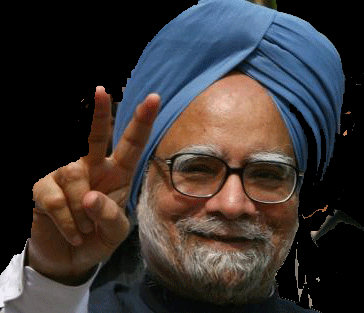 The Leader of Opposition, Shri L.K.
Advani has chosen to use all manner of abusive objectives to
describe my performance. He has described me as the weakest
Prime Minister, a nikamma PM, and of having devalued the
office of PM. To fulfill his ambitions, he has made at least
three attempts to topple our government. But on each
occasion his astrologers have misled him. This pattern, I am
sure, will be repeated today. At his ripe old age, I do not
expect Shri Advani to change his thinking. But for his sake
and India's sake, I urge him at least to change his
astrologers so that he gets more accurate predictions of
things to come.
The Leader of Opposition, Shri L.K.
Advani has chosen to use all manner of abusive objectives to
describe my performance. He has described me as the weakest
Prime Minister, a nikamma PM, and of having devalued the
office of PM. To fulfill his ambitions, he has made at least
three attempts to topple our government. But on each
occasion his astrologers have misled him. This pattern, I am
sure, will be repeated today. At his ripe old age, I do not
expect Shri Advani to change his thinking. But for his sake
and India's sake, I urge him at least to change his
astrologers so that he gets more accurate predictions of
things to come.