|
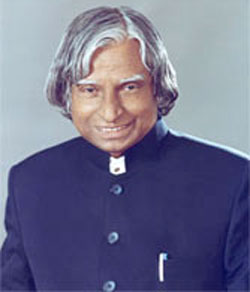
Avul Pakir
Jainulabdeen Abdul Kalam, popularly known as Dr.
A.P.J. Abdul Kalam, the son of a little educated
boat-owner in Rameswaram, Tamil Nadu, has become the
11th President of the Republic of India.
Dr. Kalam was born on October 15, 1931. He had a secured
childhood both materially and emotionally. To quote from
his autobiography Wings of Fire: “I was born into a
middle-class Tamil family in the island town of
Rameswaram in Madras state. My father, Jainulabdeen,
possessed neither much formal education nor much wealth;
despite these disadvantages, he possessed great innate
wisdom and a true generosity of spirit. He had an ideal
helpmate in my mother, Ashiamma. I do not recall the
exact number of people she fed everyday, but I am quite
certain that far more outsiders ate with us than all the
members of our own family…We lived in our ancestral
house, which was built in the middle of the 19th
century. It was a fairly large pucca house, made of
limestone and brick, on the Mosque Street of Rameswaram.
My austere father used to avoid all inessential comforts
and luxuries. However, all that was needed was provided
for, in terms of food, medicine or cloths. In fact, I
would say mine was a very secure childhood, both
materially and emotionally.” Dr. Kalam’s father
commanded a high respect as a religious man. Dr, Kalam
has acknowledged that his scientific accomplishment and
his views are very much influenced by his parents and
other well-wishers. To quote him from his autobiography
: “Every child is born, with some characteristics, into
a specific socio-economic and emotional environment, and
trained along the way, in certain ways by figures of
authority. I inherited honesty and self-discipline from
my father; from my mother, I inherited faith in goodness
and deep kindness as did my three brothers and sisters.
But it was the time I spent with Jallaluddin and
Samsuddin that perhaps contributed most to the
uniqueness of my childhood and made all the difference
in my later life. The unschooled wisdom of Jallauddin
and Samsuddin was so intuitive, responsive to non-verbal
messages that I can unhesitatingly attribute my
subsequently manifested creativity to their company in
my childhood.” It may be noted that Ahmed Jallaluddin
was a close friend of Dr. Kalam and Somesuddin was his
first cousins.
After studying in a primary school in Ramaeswaran, Dr.
Kalam went to Schwartz High School at Ramanathpuram from
where he went to Tiruchchirapalli for his higher
studies. Dr. Kalam wrote : “By the time I completed my
education at Schwartz, I was a self-confident boy with
the determination to be successful. The decision to go
in for further education was taken without a second
thought. To us, in those days, the awarness of the
possibilities for a professional education did not
exist; higher education simply meant going to college.
The nearest college was at Tiruchchirapalli, spelled
Trichinopoly those days, and called Trichi for short. “
After completing his BSc from St. Joseph’s college he
joined the Madras Institute of Technology (MIT), for
studying aeronautical engineering. From MIT, he went to
Hindustan Aeronautics Limited (HAL) at Bangalore as a
trainee. As aeronautical engineer Dr. Kalam had two
options -- in short, to join the Directorate of
Technical Development and Production, or DTD & P (Air)
of the Ministry of Defence or the Indian Air Force. As
he could not make it to Indian Air Force, Dr. Kalam
joined the Technical Centre (Civil Aviation) of the DTD&P
(Air) as Senior Scientific Assistant on a basic salary
of Rs. 250/-. While working at the Air force Directorate
he got a chance to realise his dream. He joined the
Indian Committee for Space Research (INCOSPAR), the
predecessor of the Indian Space Research Organisation (ISRO).
And thus Kalam started his much talked about career in
rocket and missile technology
Dr. Kalam has been often referred to as the "Missile Man
of India" and was the Project Director of India's first
indigenous Satellite Launch Vehicle (SLV-III). Career.
He graduated in aeronautical engineering from the Madras
Institute of Technology in 1958 and joined the Defence
Research and Development Organisation (DRDO). In 1962,
Kalam joined the Indian Space Research Organisation (ISRO).
In 1982, he rejoined DRDO as the Chief Executive of
Integrated Guided Missile Development Programme (IGMDP).
Dr. Kalam is credited with the development and
operationalisation of India's Agni and Prithvi missiles.
He worked as the Scientific Adviser to the Defence
Minister and Secretary, Department of Defence Research &
Development from 1992 to 1999. During this period , the
Pokhran-II nuclear tests were conducted. Dr. Kalam held
the office of the Principal Scientific Advisor to the
Government of India from November 1999 to November 2001.
Dr. Kalam took up teaching at Anna University, Chennai
from November 2001. He is a prolific author. His books ,
"Wings of Fire", "India 2020 - A Vision for the New
Millennium", "My journey" and "Ignited Minds -
Unleashing the power within India" have become
bestsellers. He is a favourite with children all over
the country and has met children all over the country
and has encouraged them with his learned talks.
Dr. Kalam has received a host of awards both in India
and abroad. He was awarded the Padma Bhushan in 1981,
Padma Vibhushan 1990 and the Bharat Ratna in 1997. He is
of the view that we should work wholeheartedly to make
India a developed nation by 2020.Besides being a
bachelor, Kalam is a strict disciplarinian, a complete
vegetarian and teetotaler. Among the many firsts to his
credit, he became India's first President to undertake
an undersea journey when he boarded the INS
Sindhurakshak, a submarine, from Visakhapatnam. He also
became the first president to undertake a sortie in an
fighter aircraft, a Sukhoi-30 MKI.
On November 10, 2001, Dr A.P.J. Abdul Kalam quit as
principal scientific advisor to the government. Sources
close to Kalam, said he quit because of "lack of
executive authority". However Kalam had been for quite
some time keen on pursuing academic interests and
helping scientists across the country in developing
their research capabilities. Thats why after quitting he
took over the job as distinguished professor at Anna
University.
On July 25, 2002, Dr A.P.J. Abdul Kalam was sworn in as
the 11th President of India by Chief Justice of India
B.N. Kirpal in the Central Hall of Parliament at an
impressive function telecast live across the country.
Kalam took the oath in the name of God as a 21-gun
salute boomed in the background.
A notable engineer, he is often referred to as the
Missile Man of India for his work and is considered a
progressive mentor, innovator and visionary in India. He
is also popularly known as the People's President. His
term as president ended on July 25, 2007.
Back |