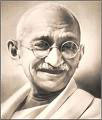
GANDHI................................................................................................................................................................................................................................................................................... Mohandas Karamchand Gandhi was born in the town of Porbandar in the state of what is now Gujarat on 2 October 1869. He had his schooling in nearby Rajkot, where his father served as the adviser or prime minister to the local ruler. Though India was then under British rule, over 500 kingdoms, principalities, and states were allowed autonomy in domestic and internal affairs: these were the so-called 'native states'. Rajkot was one such state. Gandhi later recorded the early years of his life in his extraordinary autobiography, The Story of My Experiments with Truth. His father died before Gandhi could finish his schooling, and at thirteen he was married to Kasturba [or Kasturbai], who was even younger. In 1888 Gandhi set sail for England, where he had decided to pursue a degree in law. Though his elders objected, Gandhi could not be prevented from leaving; and it is said that his mother, a devout woman, made him promise that he would keep away from wine, women, and meat during his stay abroad. Gandhi left behind his son Harilal, then a few months old. In London, Gandhi encountered theosophists, vegetarians, and others who were disenchanted not only with industrialism, but with the legacy of Enlightenment thought. They themselves represented the fringe elements of English society. Gandhi was powerfully attracted to them, as he was to the texts of the major religious traditions; and ironically it is in London that he was introduced to the Bhagavad Gita. Here, too, Gandhi showed determination and single-minded pursuit of his purpose, and accomplished his objective of finishing his degree from the Inner Temple. He was called to the bar in 1891, and even enrolled in the High Court of London; but later that year he left for India. After one year of a none too successful law practice, Gandhi decided to accept an offer from an Indian businessman in South Africa, Dada Abdulla, to join him as a legal adviser. Unbeknown to him, this was to become an exceedingly lengthy stay, and altogether Gandhi was to stay in South Africa for over twenty years. The Indians who had been living in South Africa were without political rights, and were generally known by the derogatory name of 'coolies'. Gandhi himself came to an awareness of the frightening force and fury of European racism, and how far Indians were from being considered full human beings, when he when thrown out of a first-class railway compartment car, though he held a first-class ticket, at Pietermaritzburg. From this political awakening Gandhi was to emerge as the leader of the Indian community, and it is in South Africa that he first coined the term satyagraha to signify his theory and practice of active non-violent resistance. Gandhi was to describe himself pre-eminently as a votary or seeker of satya (truth), which could not be attained other than through ahimsa (non-violence, love) and brahmacharya (celibacy, striving towards God). Gandhi conceived of his own life as a series of experiments to forge the use of satyagraha in such a manner as to make the oppressor and the oppressed alike recognize their common bonding and humanity: as he recognized, freedom is only freedom when it is indivisible. In his book Satyagraha in South Africa he was to detail the struggles of the Indians to claim their rights, and their resistance to oppressive legislation and executive measures, such as the imposition of a poll tax on them, or the declaration by the government that all non-Christian marriages were to be construed as invalid. In 1909, on a trip back to India, Gandhi authored a short treatise entitled Hind Swaraj or Indian Home Rule, where he all but initiated the critique, not only of industrial civilization, but of modernity in all its aspects. Gandhi returned to India in early 1915, and was never to leave the country again except for a short trip that took him to Europe in 1931. Though he was not completely unknown in India, Gandhi followed the advice of his political mentor, Gokhale, and took it upon himself to acquire a familiarity with Indian conditions. He travelled widely for one year. Over the next few years, he was to become involved in numerous local struggles, such as at Champaran in Bihar, where workers on indigo plantations complained of oppressive working conditions, and at Ahmedabad, where a dispute had broken out between management and workers at textile mills. His interventions earned Gandhi a considerable reputation, and his rapid ascendancy to the helm of nationalist politics is signified by his leadership of the opposition to repressive legislation (known as the "Rowlatt Acts") in 1919. His saintliness was not uncommon, except in someone like him who immersed himself in politics, and by this time he had earned from no less a person than Rabindranath Tagore, India's most well-known writer, the title of Mahatma, or 'Great Soul'. When 'disturbances' broke out in the Punjab, leading to the massacre of a large crowd of unarmed Indians at the Jallianwala Bagh in Amritsar and other atrocities, Gandhi wrote the report of the Punjab Congress Inquiry Committee. Over the next two years, Gandhi initiated the non-cooperation movement, which called upon Indians to withdraw from British institutions, to return honors conferred by the British, and to learn the art of self-reliance; though the British administration was at places paralyzed, the movement was suspended in February 1922 when a score of Indian policemen were brutally killed by a large crowd at Chauri Chaura, a small market town in the United Provinces. Gandhi himself was arrested shortly thereafter, tried on charges of sedition, and sentenced to imprisonment for six years. At The Great Trial, as it is known to his biographers, Gandhi delivered a masterful indictment of British rule. Owing to his poor health, Gandhi was released from prison in 1925. Over the following years, he worked hard to preserve Hindu-Muslim relations, and in 1924 he observed, from his prison cell, a 21-day fast when Hindu-Muslim riots broke out at Kohat, a military barracks on the Northwest Frontier. This was to be of his many major public fasts, and in 1932 he was to commence the so-called Epic Fast unto death, since he thought of "separate electorates" for the oppressed class of what were then called untouchables (or harijans in Gandhi's vocabulary, and dalits in today's language) as a retrograde measure meant to produce permanent divisions within Hindu society. Gandhi earned the hostility of Ambedkar, the leader of the untouchables, but few doubted that Gandhi was genuinely interested in removing the serious disabilities from which they suffered, just as no one doubt that Gandhi never accepted the argument that Hindus and Muslims constituted two separate elements in Indian society. These were some of the concerns most prominent in Gandhi's mind, but he was also to initiate a constructive programme for social reform. Gandhi had ideas -- mostly sound -- on every subject, from hygiene and nutrition to education and labor, and he relentlessly pursued his ideas in one of the many newspapers which he founded. Indeed, were Gandhi known for nothing else in India, he would still be remembered as one of the principal figures in the history of Indian journalism. In early 1930, as the nationalist movement was revived, the Indian National Congress, the pre-eminent body of nationalist opinion, declared that it would now be satisfied with nothing short of complete independence (purna swaraj). Once the clarion call had been issued, it was perforce necessary to launch a movement of resistance against British rule. On March 2, Gandhi addressed a letter to the Viceroy, Lord Irwin, informing him that unless Indian demands were met, he would be compelled to break the "salt laws". Predictably, his letter was received with bewildered amusement, and accordingly Gandhi set off, on the early morning of March 12, with a small group of followers towards Dandi on the sea. They arrived there on April 5th: Gandhi picked up a small lump of natural salt, and so gave the signal to hundreds of thousands of people to similarly defy the law, since the British exercised a monopoly on the production and sale of salt. This was the beginning of the civil disobedience movement: Gandhi himself was arrested, and thousands of others were also hauled into jail. It is to break this deadlock that Irwin agreed to hold talks with Gandhi, and subsequently the British agreed to hold another Round Table Conference in London to negotiate the possible terms of Indian independence. Gandhi went to London in 1931 and met some of his admirers in Europe, but the negotiations proved inconclusive. On his return to India, he was once again arrested. For the next few years, Gandhi would be engaged mainly in the constructive reform of Indian society. He had vowed upon undertaking the salt march that he would not return to Sabarmati Ashram in Ahmedabad, where he had made his home, if India did not attain its independence, and in the mid-1930s he established himself near a remote village, in the dead center of India, by the name of Segaon. He named his new home Sevagram - village of service. It is to this obscure village, which was without electricity or running water, that India's political leaders made their way to engage in discussions with Gandhi about the future of the independence movement, and it is here that he received visitors such as Margaret Sanger, the well-known American proponent of birth-control. Gandhi also continued to travel throughout the country, taking him wherever his services were required. One such visit was to the Northwest Frontier, where he had in the imposing
Pathan, Khan Abdul Ghaffar Khan (known by the endearing term of "Frontier
Gandhi", and at other times as Badshah [King] Khan), a fervent disciple. At the
outset of World War II, Gandhi and the Congress leadership assumed a position of
neutrality: while clearly critical of fascism, they could not find it in
themselves to support British imperialism. Gandhi was opposed by Subhas Chandra
Bose, who had served as President of the Congress, and who took to the view that
Britain's moment of weakness was India's moment of opportunity. When Bose ran
for President of the Congress against Gandhi's wishes and triumphed against
Gandhi's own candidate, he found that Gandhi still exercised influence over the
Congress Working Committee, and that it was near impossible to run the Congress
if the cooperation of Gandhi and his followers could not be procured. Bose
tendered his resignation, and shortly thereafter was to make a dramatic escape
from India to find support among the Japanese and the Nazis for his plans to
liberate India. The last few months of Gandhi's life were to be spent mainly in the capital city of Delhi. There he divided his time between the 'Bhangi colony', where the sweepers and the lowest of the low stayed, and Birla House, the residence of one of the wealthiest men in India and one of the benefactors of Gandhi's ashrams. Hindu and Sikh refugees had streamed into the capital from what had become Pakistan, and there was much resentment, which easily translated into violence, against Muslims. It was partly in an attempt to put an end to the killings in Delhi, and more generally to the bloodshed following the partition, which may have taken the lives of as many as 1 million people, besides causing the dislocation of no fewer than 11 million, that Gandhi was to commence the last fast unto death of his life. The fast was terminated when representatives of all the communities signed a statement that they were prepared to live in "perfect amity", and that the lives, property, and faith of the Muslims would be safeguarded. A few days later, a bomb exploded in Birla House where Gandhi was holding his evening prayers, but it caused no injuries. However, his assassin, a Marathi Chitpavan Brahmin by the name of Nathuram Godse, was not so easily deterred. Gandhi, quite characteristically, refused additional security, and no one could defy his wish to be allowed to move around unhindered. In the early evening hours of 30 January 1948, Gandhi met with India's Deputy Prime Minister and his close associate in the freedom struggle, Vallabhbhai Patel, and then proceeded to his prayers. That evening, as Gandhi's time-piece, which hung from one of the folds of his dhoti [loin-cloth], was to reveal to him, he was uncharacteristically late to his prayers, and he fretted about his inability to be punctual. At 10 minutes past 5 o'clock, with one hand each on the shoulders of Abha and Manu, who were known as his 'living walking sticks', Gandhi commenced his walk towards the garden where the prayer meeting was held. As he was about to mount the steps of the podium, Gandhi folded his hands and greeted his audience with a namaskar; at that moment, a young man came up to him and roughly pushed aside Manu. Nathuram Godse bent down in the gesture of an obeisance, took a revolver out of his pocket, and shot Gandhi three times in his chest. Bloodstains appeared over Gandhi's white woolen shawl; his hands still folded in a greeting, Gandhi blessed his assassin: He Ram! He Ram! [Oh God! Oh God!] As Gandhi fell, his faithful time-piece struck the ground, and the hands of the watch came to a standstill. They showed, as they had done before, the precise time: 5:12 P.M. |
|
||||||||||
|
|
|||||||||||