Indira Gandhi (1917-1984) was the only child of Kamla and
Jawaharlal Nehru. She spent part of her childhood in Allahabad,
where the Nehrus had their family residence, and part in
Switzerland, where her mother Kamla convalesced from her
periodic illnesses. She received her college education at
Somerville College, Oxford. A famous photograph from her
childhood shows her sitting by the bedside of Mahatma Gandhi,
as he recovered from one of his fasts; and though she was
not actively involved in the freedom struggle, she came
to know the entire Indian political leadership. After India's
attainment of independence, and the ascendancy of Jawaharlal
Nehru, now a widower, to the office of the Prime Minister,
Indira Gandhi managed the official residence of her father,
and accompanied him on his numerous foreign trips. She had
been married in 1942 to Feroze Gandhi, who rose to some
eminence as a parliamentarian and politician of integrity
but found himself disliked by his more famous father-in-law,
but Feroze died in 1960 before he could consolidate his
own political forces.
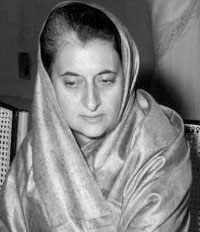
In 1964, the year of her father's death, Indira Gandhi was
for the first time elected to Parliament, and she was Minister
of Information and Broadcasting in the government of Lal
Bahadur Shastri, who died unexpectedly of a heart attack
less than two years after assuming office. The numerous
contenders for the position of the Prime Ministership, unable
to agree among themselves, picked Indira Gandhi as a compromise
candidate, and each thought that she would be easily manipulable.
But Indira Gandhi showed extraordinary political skills
and tenacity and elbowed the Congress dons -- Kamaraj, Morarji
Desai, and others -- out of power. She held the office of
the Prime Minister from 1966 to 1977. She was riding the
crest of popularity after India's triumph in the war of
1971 against Pakistan, and the explosion of a nuclear device
in 1974 helped to enhance her reputation among middle-class
Indians as a tough and shrewd political leader. However,
by 1973, Delhi and north India were rocked by demonstrations
angry at high inflation, the poor state of the economy,
rampant corruption, and the poor standards of living. In
June 1975, the High Court of Allahabad found her guilty
of using illegal practices during the last election campaign,
and ordered her to vacate her seat. There were demands for
her resignation.
Mrs. Gandhi's response was to declare a state of emergency,
under which her political foes were imprisoned, constitutional
rights abrogated, and the press placed under strict censorship.
Meanwhile, the younger of her two sons, Sanjay Gandhi, started
to run the country as though it were his personal fiefdom,
and earned the fierce hatred of many whom his policies had
victimized. He ordered the removal of slum dwellings, and
in an attempt to curb India's growing population, initiated
a highly resented program of forced sterilization. In early
1977, confident that she had debilitated her opposition,
Mrs. Gandhi called for fresh elections, and found herself
trounced by a newly formed coalition of several political
parties. Her Congress party lost badly at the polls. Many
declared that she was a spent force; but, three years later,
she was to return as Prime Minister of India. The same year,
however, her son Sanjay was killed in an airplane crash.
In the second, post-Emergency, period of her Prime Ministership,
Indira Gandhi was preoccupied by efforts to resolve the
political problems in the state of Punjab. In her attempt
to crush the secessionist movement of Sikh militants, led
by Jarnail Singh Bindranwale, she ordered an assault upon
the holiest Sikh shrine in Amritsar, called the "Golden
Temple". It is here that Bindranwale and his armed supporters
had holed up, and it is from the Golden Temple that they
waged their campaign of terrorism not merely against the
Government, but against moderate Sikhs and Hindus. "Operation
Bluestar", waged in June 1984, led to the death of Bindranwale,
and the Golden Temple was stripped clean of Sikh terrorists;
however, the Golden Temple was damaged, and Mrs. Gandhi
earned the undying hatred of Sikhs who bitterly resented
the desacralization of their sacred space. In November of
the same year, Mrs. Gandhi was assassinated, at her residence,
by two of her own Sikh bodyguards, who claimed to be avenging
the insult heaped upon the Sikh nation.
Mrs. Gandhi acquired a formidable international reputation
as a "statesman", and there is no doubt that she was extraordinarily
skilled in politics. She was prone, like many other politicians,
to thrive on slogans, and one -- Garibi Hatao, "Remove Poverty"
-- became the rallying cry for one of her election campaigns.
She had an authoritarian streak, and though a cultured woman,
rarely tolerated dissent; and she did, in many respects,
irreparable harm to Indian democracy. Apart from her infamous
imposition of the internal emergency, the use of the army
to resolve internal disputes greatly increased in her time;
and she encouraged a culture of sycophancy and nepotism.
At her death, her older son, Rajiv Gandhi, was sworn in
as head of the Congress party and Prime Minister.
|